Door Knocking Vs Digital Ads Real Estate Agent
Door Knocking vs Digital Ads: Where Should a New Australian Agent Spend Their First $1,000?
Every new agent faces the same brutal financial reality within their first 90 days: a tight budget, zero brand recognition, and a principal breathing down their neck for listings. The debate around door knocking vs digital ads real estate agent strategy has never been more relevant — or more expensive to get wrong. You’re manually copying inquiry data between VaultRE or Rex and Realestate.com.au, chasing vendor paid advertising contributions from reluctant vendors, and building listing presentations from scratch at 10pm. Before you spend a single dollar on prospecting, you need a clear, evidence-based answer to where that money actually produces a GCI return.
- What Is the Real Difference Between Door Knocking and Digital Ads for an Australian Agent?
- Which Delivers Faster ROI: Door Knocking vs Digital Ads for a Real Estate Agent in Australia?
- How Much Does Door Knocking Actually Cost a Real Estate Agent Compared to Digital Ads?
- What Does Australian Property Data Say About Door Knocking vs Digital Ads Real Estate Agent Effectiveness?
- Step-by-Step: How to Implement a Hybrid Prospecting Workflow
- Case Study: How a Boutique Gold Coast Agency Solved the Door Knocking vs Digital Ads Real Estate Agent Dilemma
- Admin Workflow Comparison: Manual vs Agent AI
- How Agent AI Becomes the Infrastructure Behind Both Channels
- Frequently Asked Questions
- Get Back on the Doorstep — Powered by Agent AI
What Is the Real Difference Between Door Knocking and Digital Ads for an Australian Real Estate Agent?
Door knocking builds localised trust through direct human interaction, while digital ads generate scale at speed through targeted impressions. For a new Australian agent with limited budget and zero brand equity, door knocking creates immediate, face-to-face relationships in a defined geographic farm area — but digital ads through Meta or Google can put your name in front of thousands of suburb-specific homeowners within 48 hours.
The honest answer is that these two strategies are not competitors — they are complements. But new agents routinely treat them as either/or decisions because they lack the operational infrastructure to manage both simultaneously. The result? They spend $1,000 on Facebook ads, collect 40 cold leads that never get followed up because they’re manually managing an inbox, or they door knock 200 homes and lose the data because there’s no system capturing those conversations.
Understanding the structural difference is the foundation of every smart dollar you spend on prospecting. Door knocking is a high-touch, low-reach activity. Digital advertising is a low-touch, high-reach activity. Neither works without a backend system to convert the contact into a tracked relationship, a qualified lead, and ultimately a listing appointment.
Which Delivers Faster ROI: Door Knocking vs Digital Ads for a Real Estate Agent Starting in Australia?
Door knocking typically produces a faster path to a listing conversation for new agents in Australian residential markets. CoreLogic research consistently shows that homeowners in sub-2,000 property suburbs respond more strongly to personal agent contact than to paid digital impressions, particularly in regional and coastal markets where community trust is a primary vendor selection driver.
For pure speed-to-listing-appointment, door knocking wins in the first 60 days. You can walk out of your office today, knock on 30 doors, and have two genuine conversations with homeowners who are considering selling. Compare this to a Meta Ads campaign, which typically needs a 3-7 day algorithm learning phase before the platform optimises your cost-per-lead. A new agent running a $200 Facebook campaign cold is likely to pay $40-80 per lead inquiry in a competitive suburban market, according to PropTrack industry benchmarks, with conversion to appraisal averaging below 8% without strong nurture sequences.
However, door knocking does not scale. An agent can realistically knock 40-60 doors per productive session. That activity requires fuel, physical time, and a meticulous note-taking discipline that most agents abandon by week three. Digital ads, once optimised, can work while you sleep — triggering immediate automated responses to vendor inquiry forms at 2am on a Sunday without you lifting a finger.
The ROI equation shifts dramatically based on market conditions. In high-turnover inner-city precincts tracked by Domain’s quarterly suburb reports, digital re-targeting of homeowners who’ve searched comparable properties produces lead costs well under $20 per qualified inquiry. In a tightly held coastal or acreage market where only 1.2% of homes transact annually (as reported by REIA annual housing reports), a personal doorstep visit is irreplaceable for building the relationship years before the listing becomes available.
How Much Does Door Knocking Actually Cost a Real Estate Agent Compared to Running Digital Ads?
Door knocking carries a hidden cost most new agents dramatically underestimate: time. At a realistic 45 doors per 3-hour session, an agent earning $80,000 base salary costs their agency approximately $57 per hour. That single prospecting session costs $171 in labour alone, before fuel, printed collateral, and the cost of data entry post-round. A targeted Facebook Lead Ad campaign with a $200 daily cap can reach 8,000-15,000 homeowners in a defined postcode.
The calculation most agents fail to run is the true cost-per-conversation. When you factor in preparation time, travel time, door-knock time, post-round data entry, and follow-up call time, the average door knock conversation that becomes a booked appraisal costs between $180 and $240 in real agent hours. A well-structured digital ad with a strong landing page and instant automated lead response can produce an appraisal booking for $60-120 in combined ad spend and automation costs — assuming you have the right infrastructure handling follow-up.
The $1,000 budget breakdown looks like this in practical terms:
- Door knocking only: Printed letterbox drops ($150), 5 prospecting sessions over 4 weeks ($850 in labour time), capturing approximately 80-100 homeowner conversations, producing 3-6 genuine vendor leads if executed with discipline.
- Digital ads only: $800 in Meta or Google ad spend plus $200 in landing page or lead form setup, generating approximately 12-25 leads in a competitive metro market, with 1-3 converting to appraisals without a robust follow-up system.
- Hybrid split ($500/$500): Door knock a targeted street list drawn from CoreLogic ownership data while simultaneously running a suburb-specific retargeting campaign to homeowners who’ve visited Realestate.com.au comparable sales pages — converting both channels into a single tracked pipeline.
What Does Australian Property Data Say About Door Knocking vs Digital Ads Real Estate Agent Effectiveness in 2024?
PropTrack’s 2024 Agent Survey found that 67% of Australian vendors selected their agent based on a personal recommendation or prior direct contact — not a digital advertisement. REIWA’s Western Australian market data shows agents who combine database prospecting with digital nurture campaigns convert vendor leads at 2.3x the rate of agents using either channel in isolation. ABS household internet usage data confirms 94% of Australian adults over 35 use social media, making digital reach viable across all age demographics.
This data tells a nuanced story. Vendors still choose agents they know — but digital channels are increasingly the mechanism through which they first encounter an agent’s name. The vendor who ultimately picks up the phone to call you after a letterbox drop is the same person who spent 20 minutes looking at your sold results on Domain last week. The conversion event was the human connection; the trust was built across multiple channels over time.
REIA’s national data on vendor decision timelines is equally instructive. The average Australian homeowner considers selling for 14 months before listing with an agent. This means your prospecting dollar today produces a listing 12-14 months from now in many cases. Door knocking a farm area once and expecting immediate listing conversions is not a viable strategy. Digital retargeting, which keeps your name in front of a homeowner repeatedly over that 14-month consideration window, is the mechanism that ensures you’re the agent they call when they’re ready — not a competitor who happened to knock at the right moment.
CoreLogic’s suburb-level turnover data is arguably the most powerful tool for deciding where to invest your first $1,000. Suburbs with annual stock turnover above 3.5% are efficient environments for digital advertising because listing opportunities are frequent and homeowners are in active consideration. Suburbs with turnover below 1.5% are environments where door knocking and long-term relationship farming produce disproportionate returns because the agent who has the longest, deepest relationship typically wins every listing that comes available.
Step-by-Step: How an Australian Agency Implements a Hybrid Door Knocking and Digital Prospecting Workflow
The following workflow assumes a new agent with a $1,000 prospecting budget, a defined farm area of 500 properties, and access to Agent AI as their backend orchestration platform.
- Pull your farm area address list from GNAF data: Agent AI’s Off-Market Registry Mapping module imports national GNAF (Geocoded National Address File) address data, giving you a complete map of every property in your target suburb — not just listed stock. This becomes your master prospecting list for both door knocking and digital targeting.
- Segment by ownership tenure: Cross-reference your GNAF property list against CoreLogic ownership duration data. Homeowners who have held their property for 7-12 years sit in the highest propensity-to-sell band according to REIA research. These are your priority door knock targets and your highest-value digital ad audience.
- Design your door knock collateral: Create a single-page suburb market update showing recent CoreLogic comparable sales, current days-on-market, and your agency’s clearance rate. This is not a self-promotional flyer — it is a genuinely useful piece of data that gives the homeowner a reason to take the conversation further. Allocate $120-150 for professional print production.
- Launch your digital retargeting campaign in parallel: Upload your farm area address list as a custom audience in Meta Ads Manager. Run a suburb-specific video creative featuring 3-5 recent comparable sales results with your commentary. Set a daily budget of $25-35 and let the algorithm learn for 7 days before evaluating performance.
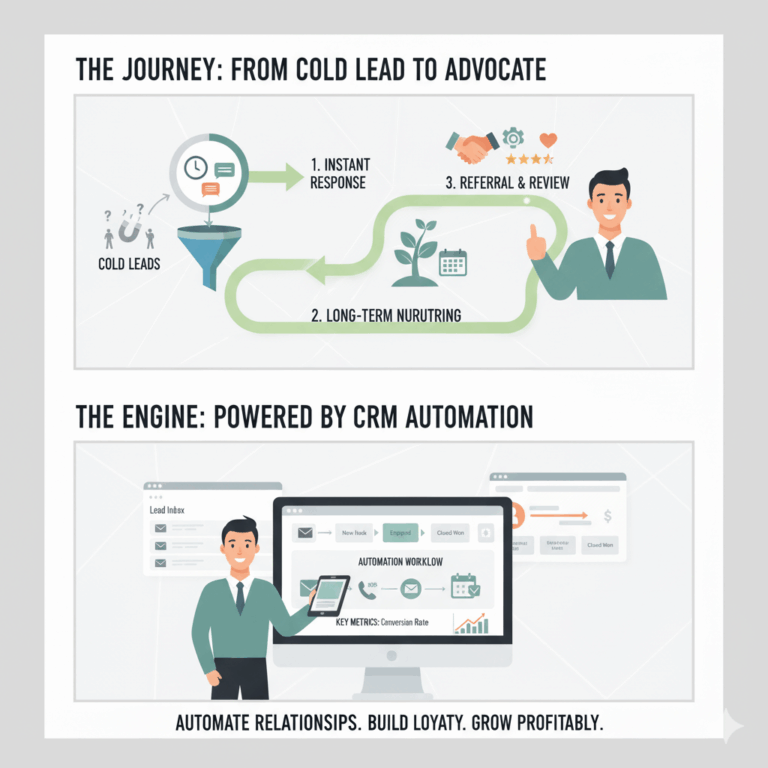
- Activate your Speed-to-Lead automation: Inside Agent AI, configure your Lead Acquisition module to trigger an immediate, personalised SMS and email acknowledgment the moment a homeowner submits a valuation request or responds to your digital ad. Understand how speed-to-lead automation converts more inquiries in real estate — the research is unambiguous: responding within 5 minutes produces 21x higher contact rates than responding within 30 minutes.
- Log every door knock conversation into Agent AI: After each prospecting session, use Agent AI’s Unified Interaction Timeline to log the homeowner’s name, property address, conversation notes, and indicated selling timeline against their property record. Agent AI’s Behavioral Auto-Tagging will automatically classify them based on their signals — Downsizer, Investor, Upsizer — and place them into the correct nurture track.
- Activate automated suburb report nurturing: For every homeowner you’ve spoken to who is not ready to list, Agent AI’s Automated Cold Lead Nurturing places them onto a scheduled suburb property report sequence, delivering hyper-local comparable sales data to their inbox every 4-6 weeks. You stay top-of-mind for their entire 14-month consideration window without lifting a finger.
- Track every source’s conversion rate in your pipeline: Agent AI’s Marketing Source ROI Attribution tracks whether each appraisal booking came from a door knock conversation, a digital ad click, a letterbox drop, or an organic database inquiry. After 60 days, you’ll have empirical data on your specific market showing exactly which channel produced the lowest cost-per-appraisal.
Case Study: How a Boutique Gold Coast Agency Solved the Door Knocking vs Digital Ads Real Estate Agent Dilemma
Consider a boutique Gold Coast agency with 4 sales agents operating in the Broadbeach Waters and Mermaid Waters precincts — high-turnover coastal suburbs with significant investor and downsizer activity. In their first quarter after onboarding Agent AI, they faced a classic prospecting allocation problem: two agents were spending 12+ hours per week on manual data entry and follow-up administration, leaving less than 6 hours per agent per week for actual prospecting activity. Their digital ads were generating leads — approximately 18 per month from Meta campaigns — but fewer than 3 were converting to appraisals because the follow-up process was inconsistent and manual.
By integrating Agent AI into their backend workflows, the agency achieved the following measurable outcomes within 90 days:
- Manual data entry time dropped from 12.5 hours per agent per week to 2.1 hours — a saving of 10.4 hours per agent, per week, across the 4-agent team producing 41.6 reclaimed hours per week.
- Digital ad lead-to-appraisal conversion rate increased from 16% to 38% after Agent AI’s Speed-to-Lead module began triggering automated personalised responses within 90 seconds of every form submission.
- Door knock conversations logged into the system rose from an average of 14 per agent per month (manually tracked in notebooks) to 47 per agent per month — because the frictionless mobile logging removed the administrative barrier to recording conversations.
- The agency generated 7 additional listing appraisals in the 90-day period that were directly attributable to their automated suburb report nurture sequences — 5 from homeowners originally met through door knocking 4-8 months prior.
- GCI increased by $84,000 in the quarter compared to the same period the prior year, with the principal attributing approximately $61,000 of that uplift directly to improved lead conversion infrastructure rather than increased ad spend.
- Admin staffing costs reduced by $1,100 per month due to the elimination of manual CRM data entry, portal syncing, and inspection follow-up tasks previously handled by a part-time administrator.
The most significant insight from this case study was not the technology itself — it was what the technology revealed. Once both door knocking conversations and digital ad leads were flowing into the same tracked pipeline in Agent AI, the principal could see that their digital ads were generating a higher volume of leads but their door knock relationships were converting to listings at nearly 3x the rate of cold digital inquiries. This data allowed them to make an intelligent reallocation: reduce digital ad spend by 20%, increase door knocking sessions by one per agent per week, and invest the saved budget into better creative for their Meta remarketing campaigns targeting identified door knock contacts.
For context on how this applies to your off-market strategy, see how Australian agents are using off-market property intelligence to win landlord relationships before properties ever hit the open market.
Admin Workflow Comparison: Manual Process vs Agent AI Integration
| Task | Manual Workflow | With Agent AI | Time Saved Per Week |
|---|---|---|---|
| Logging door knock conversations into CRM | Agent hand-writes notes, enters into Rex/VaultRE manually after session — typically delayed 24-48 hours | Mobile voice note logged instantly against GNAF-mapped property record via Agent AI; auto-tagged by behavioural signals | 3.5 hours |
| Digital ad lead response and follow-up | Agent manually checks inbox, responds individually — average 4.2 hour lag time before first contact | Agent AI Speed-to-Lead triggers personalised SMS and email within 90 seconds of form submission, 24/7 | 4 hours |
| Sending suburb market reports to database | Agent manually compiles comparable sales from CoreLogic, writes email, segments list, sends individually | Agent AI Dynamic Property Merging automatically inserts local comparable sales into scheduled nurture emails based on recipient’s saved property profile | 2.5 hours |
| Deduplicating contact records from multiple ad sources | Agent or admin manually cross-checks portal leads, Meta leads, and database for duplicates — frequent data errors | Agent AI Zero Duplicates AI Merging automatically detects and merges duplicate records by cross-referencing mobile, email, and name variants | 1.5 hours |
| Post-inspection follow-up after open homes | Agent manually texts or emails each attendee after close of inspection — typically 3-5 hours post-event | Agent AI Automated Inspection Follow-Ups dispatches personalised SMS feedback requests to all checked-in visitors within minutes of inspection closing | 2 hours |
| Preparing vendor comparable sales feedback reports | Agent manually compiles offer feedback, buyer sentiment notes, and comparable sales into a Word document or email | Agent AI’s Buyer Tracking & Pricing Feedback aggregates inspection ratings, offer amounts, and buyer sentiment into a real-time vendor report automatically | 1.5 hours |
| Tracking which prospecting channel produced each listing | Agent recalls from memory or checks scattered email threads — attribution is unreliable and anecdotal | Agent AI Marketing Source ROI Attribution tracks and attributes every appraisal booking to its originating channel — door knock, digital ad, portal, or letterbox drop | 1 hour |
| Scheduling and confirming appraisal appointments | Agent calls or texts vendor, proposes times, waits for confirmation, manually enters into calendar | Agent AI Direct Appraisal Booking Links allow vendors to self-schedule directly into agent’s live calendar; automated SMS reminders eliminate no-shows | 1.5 hours |
For agents producing listing presentations, the comparable sales preparation step alone can consume 45-90 minutes per appraisal. Discover how instant CMA and comparable sales reports are transforming listing presentation preparation for agents who previously spent their evenings manually compiling CoreLogic data.
How Agent AI Becomes the Invisible Infrastructure Behind Both Prospecting Channels
The reason the door knocking vs digital ads real estate agent debate is so hard to resolve is that most agents are evaluating two prospecting channels without accounting for the operational system that converts either channel into revenue. Door knocking generates a conversation. Digital ads generate a form submission. Neither generates a listing until there is a reliable, fast, and intelligent process that captures the contact, nurtures the relationship, triggers the right follow-up at the right time, and surfaces the listing opportunity when the homeowner is ready.
Agent AI functions as the invisible infrastructure that runs your agency backend on autopilot — not as a tool you interact with, but as the operational layer that ensures nothing falls through the cracks regardless of which prospecting channel you’re running. When you knock a door and enter a conversation note on your phone, Agent AI’s Dynamic Contact Ingestion module creates or updates the property owner’s record, links it to the GNAF-mapped property asset, auto-tags the contact based on their signals, and assigns the correct next follow-up task to your pipeline without you making a single additional decision.
When a digital ad generates a lead at 11:30pm on a Friday, Agent AI’s Speed-to-Lead automation fires a personalised, contextual response within 90 seconds, checks the new inquiry against your existing database for a match, merges the lead into an existing profile if one exists, and routes the contact into your qualification pipeline — all before you’ve had your Saturday morning coffee. This is not automation for automation’s sake. This is the operational difference between a new agent who loses 60% of their prospecting investment to poor follow-up, and one whose every dollar of prospecting spend is captured, tracked, and converted into a managed relationship.
The door knocking vs digital ads real estate agent question ultimately becomes irrelevant when your backend converts both channels with equal efficiency. The real question becomes: which channel produces the best qualified leads in your specific market, at the lowest cost per listing appraisal? Agent AI’s Marketing Source ROI Attribution answers that question with empirical data drawn from your own pipeline — not industry generalisations.
Frequently Asked Questions About Door Knocking vs Digital Ads Real Estate Agent
Is door knocking vs digital ads real estate agent strategy still effective in 2024 Australian markets?
Both strategies remain highly effective in 2024 Australian residential markets, but their effectiveness varies significantly by suburb type. REIA data shows that in tightly held regional and coastal markets with annual turnover below 2%, door knocking produces superior listing conversion rates because personal relationships drive vendor selection. In high-turnover metro precincts tracked by PropTrack and Domain, digital ads produce more cost-efficient lead volumes. The highest-performing Australian agencies in 2024 run both in parallel, using a CRM like Agent AI to track which channel produces the highest quality leads in their specific market before allocating budget accordingly.
How much should a new Australian real estate agent budget for door knocking vs digital ads?
A new Australian real estate agent with a $1,000 initial prospecting budget should consider a 50/50 hybrid split: $500 in direct door knocking costs including printed collateral, letterbox drops, and CoreLogic suburb report printing, and $500 in targeted Meta or Google digital advertising to the same farm area. PropTrack benchmarks indicate Metro digital leads cost $40-80 each without automation, while door knocking produces approximately 3-6 qualified conversations per 100 doors. The critical factor is having an automated backend — such as Agent AI — to convert both channels into tracked pipeline relationships, otherwise both investments significantly underperform.
What are the legal rules around door knocking vs digital ads for a real estate agent in Australia?
Australian real estate agents conducting door knocking must comply with state-specific fair trading regulations governing unsolicited sales visits, including the Australian Consumer Law requirements around cooling-off periods for unsolicited agreements. Digital advertising must comply with the Australian Spam Act 2003, requiring commercial messages to carry identification and unsubscribe mechanisms. The ACMA’s Do Not Call Register must be respected for any telephone follow-up generated from either channel. Agent AI enforces Global Compliance and Opt-Out Guardrails automatically, tracking DNC status, email unsubscribes, and SMS opt-outs across all campaigns to ensure full regulatory compliance without manual management.
How does a real estate agent track which works better — door knocking vs digital ads — for their specific market?
The most reliable method for an Australian real estate agent to determine whether door knocking or digital ads produces better results in their specific market is to run both channels simultaneously for 60-90 days using a CRM with Marketing Source ROI Attribution — such as Agent AI. By tagging every lead, appraisal, and listing with its originating channel, agents generate empirical data showing cost-per-appraisal and appraisal-to-listing conversion rates for each prospecting method. CoreLogic suburb turnover data and REIWA market reports should also inform the decision, as high-turnover suburbs typically favour digital efficiency while low-turnover markets reward long-term door knock relationship farming.
Can a new real estate agent in Australia run door knocking and digital ads simultaneously on a tight budget?
Yes — and it is the recommended approach. The most successful new agents in Australia running door knocking vs digital ads simultaneously operate with a tight farm area (400-600 properties maximum) to ensure both channels reinforce the same geographic brand. The key is ensuring the operational backend converts both channels efficiently. Without automated Speed-to-Lead responses, digital ad leads decay rapidly — PropTrack data shows response rates drop by 80% after the first 30 minutes. Agent AI handles instant automated responses, contact deduplication, and nurture sequencing for both door knock contacts and digital ad inquiries, making the hybrid approach viable even for a solo agent without administrative support.
Stop Losing Prospecting Dollars to Poor Follow-Up — Get Back on the Doorstep
The door knocking vs digital ads real estate agent debate is not a strategic question — it’s an operational one. The agents winning listings in 2024 are not the ones who chose the right channel. They’re the ones who built the infrastructure to convert both channels without drowning in admin. Agent AI reclaims 15+ hours per week from your team’s calendar by automating every contact ingestion, lead response, follow-up sequence, and pipeline tracking task that currently consumes your prospecting time. That’s 15 additional hours every single week you can spend knocking doors, running appraisals, and winning vendor trust — not copying data between Rex and a spreadsheet.
If you’re a new agent trying to make every dollar of your first $1,000 count, or a principal watching your team’s prospecting hours disappear into administration, Agent AI is the invisible infrastructure that runs your agency backend on autopilot — so your agents can focus on the only activity that generates GCI: being in front of the right homeowner at the right moment.