See it in action
Your database, working for you.
Real-time visibility into every contact, every campaign, every reply — all in one place.
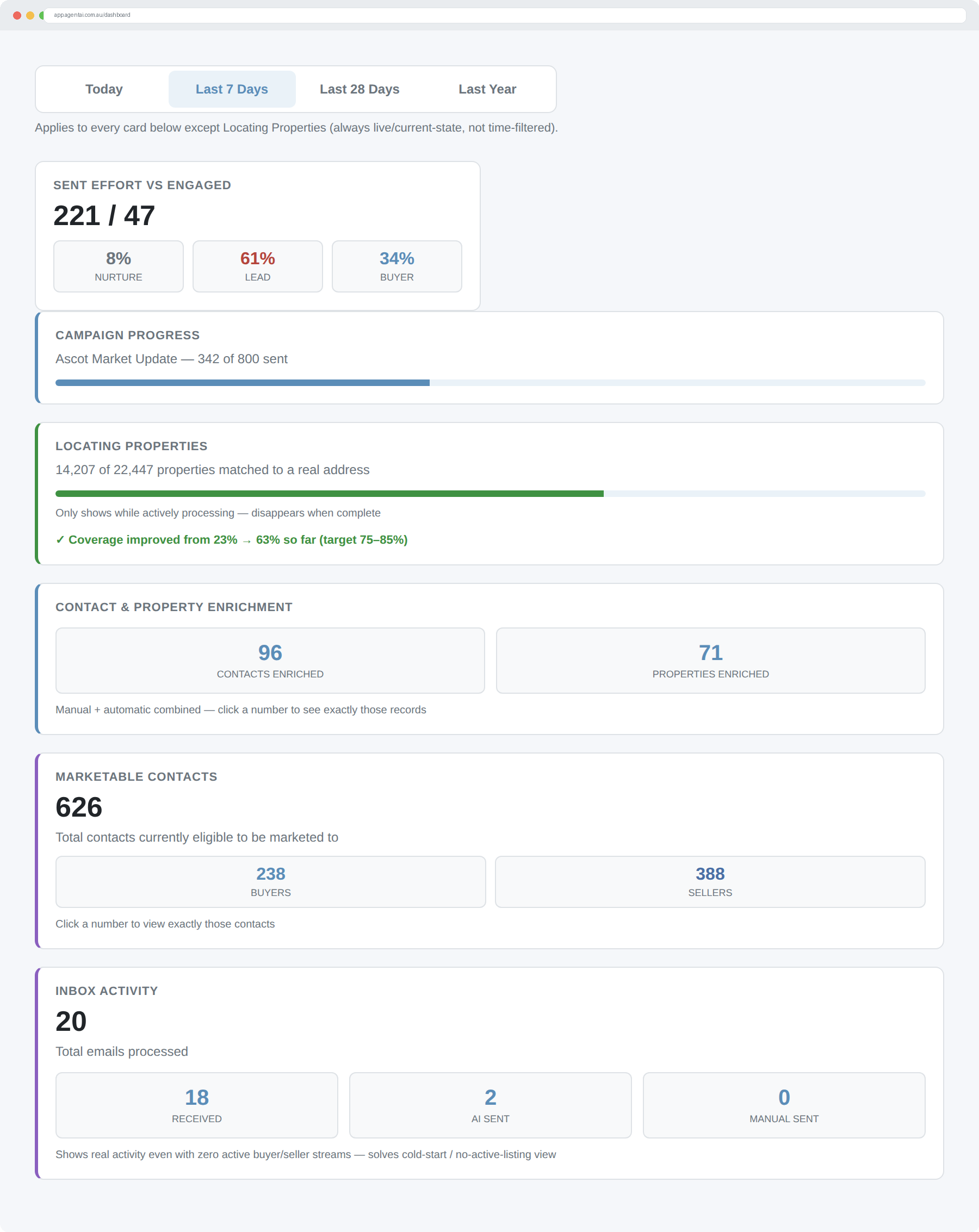
Keep your current CRM for agency admin. AgentAI runs quietly alongside your current setup, intelligently tracking local market sales, nurturing past clients, and surfacing warm seller leads without you lifting a finger.
Zero retraining, zero complex setup. AgentAI runs quietly in the background while you focus on selling homes.
Send us your contact export and we will clean, format, and configure your database setup for you. Zero tech hassle on your end.
AgentAI continuously monitors your database, matching property owners against recent nearby sales to spot who is statistically due to list.
Personalised SMS updates go out automatically using your dedicated AU mobile number. Fully compliant with spam laws and styled to sound like you.
When an owner replies, AgentAI alerts you instantly with their full context—so you walk into that appraisal ready to win the listing.
Real-time visibility into every contact, every campaign, every reply — all in one place.
The moment a property sells near one of your contacts, AgentAI reaches out automatically with a hyper-local update—triggering the appraisal conversation before any other agent gets there first.
Never waste time on dead numbers. AgentAI automatically checks ownership status across your list, identifying active homeowners and surfacing contacts who are statistically due to list.
The buyers of 5 years ago are the sellers of today. AgentAI keeps you front-of-mind with intelligent, long-term nurturing so you're the only agent they call when they're ready to list.
Includes a real Australian mobile number. When an owner replies to an automated SMS, the message alerts your mobile instantly so you can step in and lock down the meeting.
No painful migrations or office approvals. Keep your current agency system for admin and compliance; run AgentAI alongside it as your personal listing co-pilot.
Your database is completely private and encrypted. AgentAI never pools agent data. If you change agencies tomorrow, your contacts and campaign history go with you—not the principal.
"Agents tell me they are too busy to keep their data correct. Contacts sitting idle. Past clients listing with someone else. Buyers who were ready to sell — and nobody knew. I built AgentAI because I knew exactly what was being lost. Not as a tech person guessing at what agents need — but what agents told me they needed."
Never. Your database lives in a completely private, encrypted environment. AgentAI does not pool agent data — ever. Your contacts belong to you alone. If you change agencies tomorrow, your data comes with you.
Yes — built specifically for the Australian market. Every outreach automatically respects opt-out requests and Do Not Contact flags. You never have to think about compliance.
None. AgentAI works independently of your current CRM — send us your contact export and we set it up to run alongside whatever system your agency uses.
$99/month or $990/year for founding members. Your plan includes AI credits and 30 SMS messages so you can see it working straight away. Additional SMS messages are billed at 7c each, and extra AI credits are available if your database is large. Annual members get day one access and save $198 on their first year.
We are targeting early access from January 2027. Annual members get priority day one access.
Drop your email below to reserve your spot on the waitlist.